We have compiled a list of manufacturers, distributors, product information, reference prices, and rankings for Quantum chemistry computer.
ipros is IPROS GMS IPROS One of the largest technical database sites in Japan that collects information on.

Quantum chemistry computer - List of Manufacturers, Suppliers, Companies and Products | IPROS GMS

Quantum chemistry computer Product List

1~3 item / All 3 items

Displayed results

[Analysis Case] Evaluation of Reduction Resistance of LIB Electrolyte by Quantum Chemistry Calculations

Comparison of the reduction resistance of solvents and additives in the electrolyte, and estimation of the structure of decomposition products is possible.

A film (SEI) is formed at the interface between the anode of lithium-ion batteries (LIB) and the electrolyte, and its characteristics significantly affect battery performance. Research and development of functional electrolytes aimed at generating films with excellent ionic conductivity that contribute to the stability of batteries is underway. Quantum chemical calculations can be utilized in the design of such electrolytes and films. This document evaluates the electron affinity of solvents and additives in LIB electrolytes through quantum chemical calculations and assesses their reduction resistance. Additionally, the structure of reduction products can be estimated from bond dissociation energy. Measurement methods: Computational science, AI, data analysis Product field: Secondary batteries Analysis purpose: Composition evaluation, chemical bonding state evaluation For more details, please download the document or contact us.

  • img_C0716_2.jpg
  • Contract Analysis
  • Quantum chemistry computer

Added to bookmarks

Bookmarks list

Bookmark has been removed

Bookmarks list

You can't add any more bookmarks

By registering as a member, you can increase the number of bookmarks you can save and organize them with labels.

Free membership registration

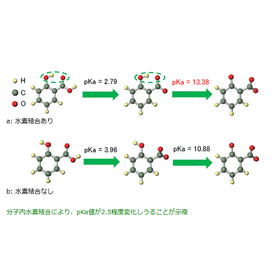
[Analysis Case] Calculation of Acid Dissociation Constant (pKa) Using Quantum Chemistry Calculations

It is possible to predict the pKa of compounds with unknown pKa based on calibration curves created for each solvent and functional group!

Our organization conducts calculations of acid dissociation constants (pKa) using quantum chemistry. The acid dissociation constant (pKa) is one of the indicators that quantitatively represents the strength of an acid (the ease of proton dissociation). Knowing the pKa helps in estimating the solubility of compounds in relation to pH, their state, the ease of absorption of pharmaceuticals in the body, and pH buffering effects. Using the acid dissociation energy differences obtained from quantum chemical calculations and experimental pKa values, we create calibration curves for different solvents and functional groups, and present examples of studies investigating the impact of intramolecular hydrogen bonding on pKa. [Measurement Methods and Processing Methods] ■ Computational Science, AI, Data Analysis *For more details, please download the PDF or feel free to contact us.

  • 1.png
  • Contract Analysis
  • Quantum chemistry computer

Added to bookmarks

Bookmarks list

Bookmark has been removed

Bookmarks list

You can't add any more bookmarks

By registering as a member, you can increase the number of bookmarks you can save and organize them with labels.

Free membership registration

What can be understood from quantum chemistry calculations

Quantum chemistry calculation

Quantum chemical calculations can provide molecular insights (such as molecular structure, charge distribution, molecular orbitals, and mechanisms of chemical reactions) that serve as guidelines for the development and design of materials, as well as simulate various response spectra like UV-Vis and NMR with high accuracy. The results obtained can help overcome various challenges faced in research and development in fields such as functional materials and drug discovery. This document introduces the analysis targets, the physical property information obtained, and case studies that can be understood from quantum chemical calculations.

  • Contract Analysis
  • Quantum chemistry computer

Added to bookmarks

Bookmarks list

Bookmark has been removed

Bookmarks list

You can't add any more bookmarks

By registering as a member, you can increase the number of bookmarks you can save and organize them with labels.

Free membership registration